
Designing Yours · 4 min read
By AuraMade ·
How to Design a Custom Crystal Bracelet You'll Actually Wear
A wearable custom bracelet needs a clear anchor and a repeatable pattern. Choose one story or color, build it with an alternating, centered, or gradient formula, then edit the complete circle for contrast, wrist fit, and everyday comfort.
Write a one-sentence design brief
Describe where the bracelet belongs in your life: an everyday neutral piece, a graduation gift, a bright design for presentations, or a bracelet worn beside a watch. Then name the one stone, color, charm, or memory that should lead.
This brief gives each choice a job. A material stays because it supports the story, palette, or structure, not simply because it was available in the catalog.
Choose one of three bracelet pattern formulas
| Pattern | Example sequence | Use it when |
|---|---|---|
| Alternating | A-B-A-B-A-B | Two stones deserve equal visual weight and a steady rhythm |
| Centered | A-A-B-C-B-A-A | A charm or focal bead should lead with mirrored support |
| Gradient | Light A-A-B-B-C-C Dark | Color should move gradually rather than repeat evenly |
The letters represent roles, not specific stones. For example, A could be clear quartz, B amethyst, and C a single smoky quartz focal bead. Repeat or shorten the formula to fit the full bracelet.
Build a palette of two or three tones
- Main color: the stone that carries the design at a glance.
- Supporting color: a material that creates useful contrast without competing.
- Optional neutral: clear, white, gray, or a restrained metal detail that separates stronger colors.
Compare the palette with clothing and jewelry you already wear. If it only works with one special outfit, simplify the accents or change the metal tone before adding another stone.
Use contrast once, then repeat it
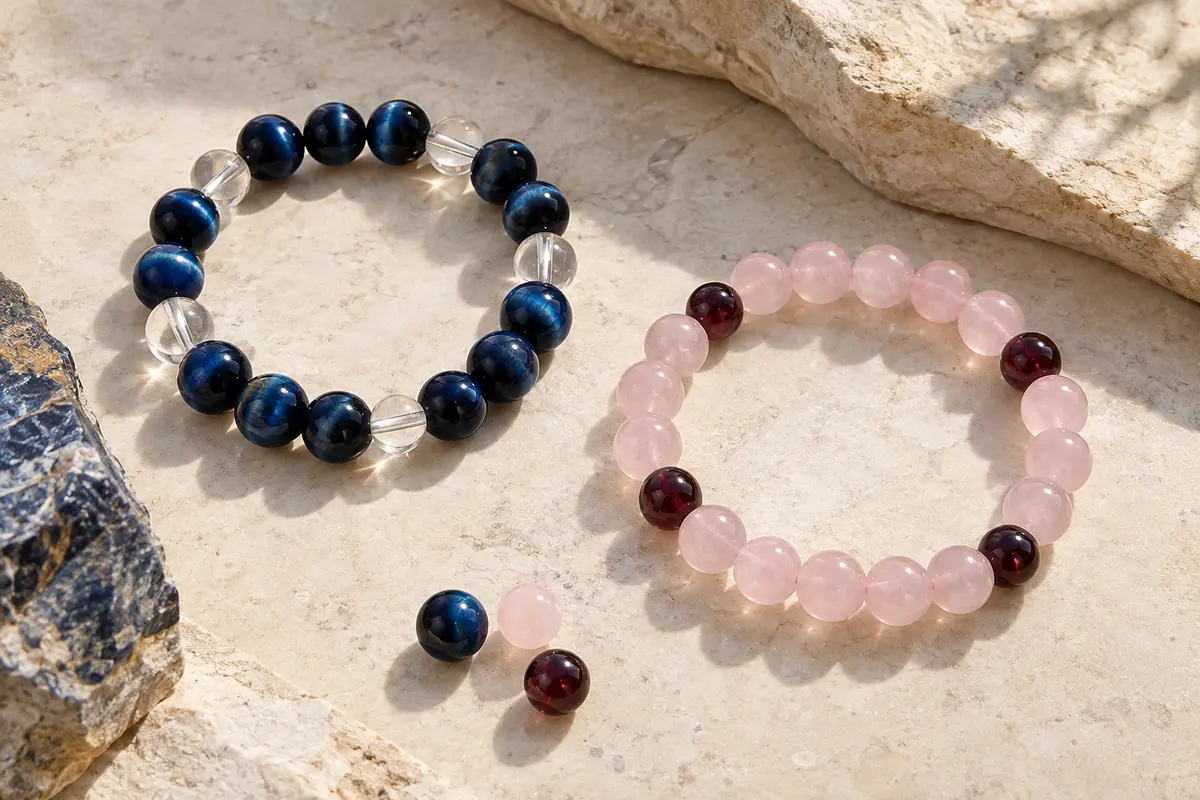
Contrast can come from color, finish, size, or metal. Deep blue beside clear quartz creates color contrast; a matte bead beside polished stones creates surface contrast. One strong type of contrast is usually enough.
When the arrangement feels scattered, remove the least important accent before adding a new material. Repeating a neutral bead between strong colors can reconnect the pattern.
Edit the bracelet in three passes
- Structure pass: confirm bead size, approximate wrist fit, and the main repeating pattern.
- Color pass: keep the anchor, one supporting tone, and a neutral only if it adds clarity.
- Detail pass: add a charm or spacer, then compare the edited design with the simpler saved version.
View the bracelet as a complete circle. A sequence that looks balanced in a straight row can place the focal point awkwardly when it wraps around the wrist.
Design for the actual wrist and routine
Bead diameter and wrist circumference change how many times a formula can repeat. Select the bead size, compare the Builder's recommended wrist range with the intended wrist, and then recheck the focal position.
Also consider typing, long sleeves, exercise, and stacking. A design intended for daily wear may benefit from fewer accents and a lower profile than a bracelet worn alone for special occasions.
Design a bracelet for someone else
Use evidence instead of assumptions. Look at the recipient's usual jewelry, ask about favorite colors, and notice whether they prefer small details or statement pieces. Include the personal reference through one color, charm, or pattern rather than trying to represent every memory.
Do not guess wrist circumference from height, age, gender, or clothing size. Measure a bracelet they wear comfortably or ask for the wrist measurement before production.
Custom bracelet design questions
How many stones should a custom bracelet use?
One stone can create a complete bracelet, and two or three can create useful contrast. Add another material only when it improves the visible pattern.
Does a centered design need perfect symmetry?
No. Symmetry is a starting structure. The final bead count or a natural focal bead may require a small intentional break in the mirror.
Will natural beads repeat exactly like the preview?
No. Natural stones vary in color, clarity, pattern, and inclusions. Design around color roles and spacing instead of exact surface markings.