
Fit and Sizing · 3 min read
By AuraMade ·
How to Measure Your Wrist for a Crystal Bracelet
Wrap a flexible tape around the bare wrist where the bracelet will sit, keep it against the skin without pulling tight, and record the raw circumference to the nearest millimeter. Do not add a guessed comfort allowance: compare the original measurement with the recommended wrist range shown for the bracelet design.
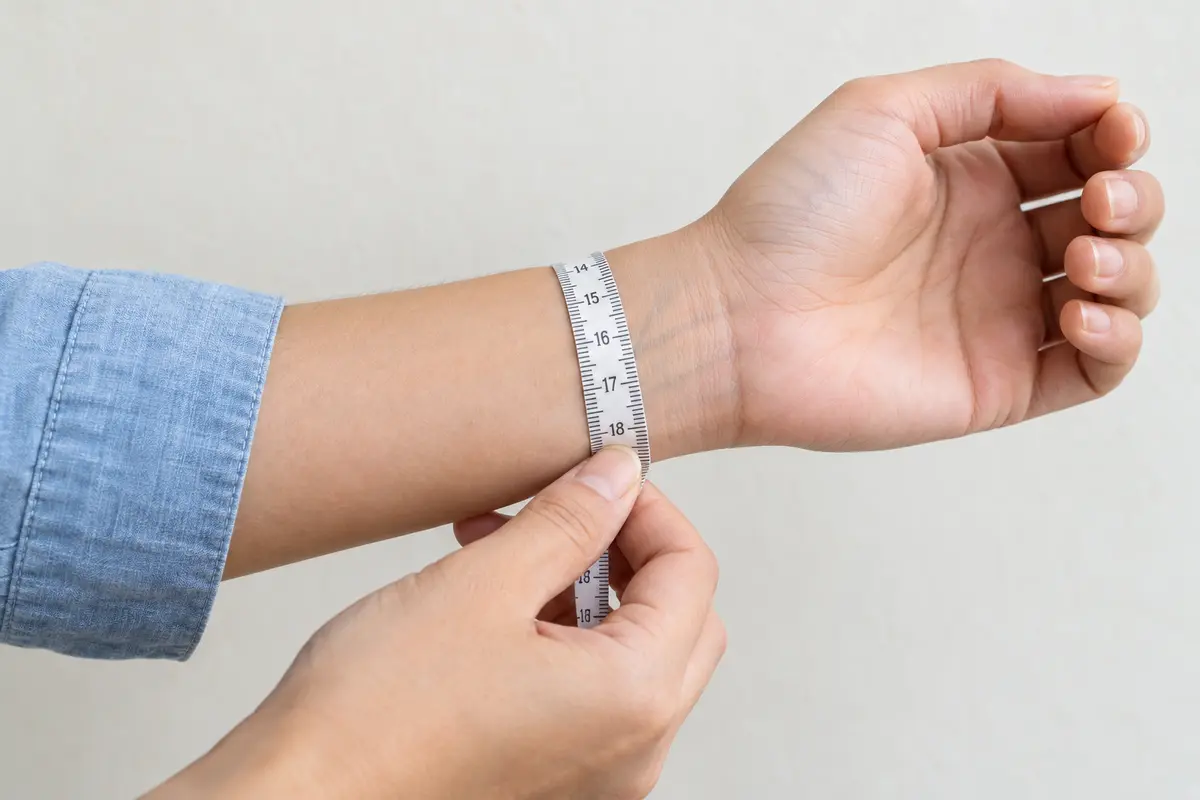
Measure your wrist in four steps
- Use a flexible measuring tape. If you do not have one, use a narrow strip of paper or non-stretch string plus a ruler.
- Measure the bare wrist at the exact place where the bracelet will sit. Keep the hand relaxed.
- Bring the tape or strip against the skin without digging in, overlapping, or leaving a visible gap.
- Record the meeting point to the nearest millimeter or the smallest marking you can read, then repeat the measurement once.
Record the raw wrist circumference
If the wrist measures 16.2 cm, write down 16.2 cm rather than rounding to 16 or 17. One inch equals 2.54 cm if you need to convert the result. Keep a note of which wrist you measured because the two wrists can differ.
Do not measure the hand, forearm, or a layer of clothing. Avoid measuring immediately after exercise or when the wrist is temporarily swollen.
Do not add comfort allowance twice
| Part of the fit | Your action | AuraMade Builder |
|---|---|---|
| Raw wrist circumference | Measure and keep the exact result | Uses it as the comparison target |
| Bead diameter | Choose the visible bead size | Accounts for its effect on the finished circle |
| Accessories and spacers | Place the parts you want | Includes their occupied width in the fit calculation |
| Comfort range | Compare with your preference | Shows the recommended wrist range for the full sequence |
Measuring loosely and then adding another guessed amount makes the bracelet larger twice. Keep the measurement exact and use the recommended range to decide whether the design should stay close or allow more movement.
Use an existing bracelet as a second check
A bracelet that already feels comfortable can help confirm your preference, but it should not replace the wrist measurement. Measure its inside circumference or inside opening without stretching the elastic.
A worn elastic bracelet may have changed shape, and a rigid bangle fits differently from a round-bead elastic bracelet. Treat the comparison as supporting evidence rather than the final size.
Account for bead size after measuring
The same wrist circumference needs a different number of 6mm, 8mm, and 10mm beads. Charms and spacers also occupy part of the circle. Choose the bead size and complete the sequence before judging the final recommended wrist range.
Handle small or large wrists without guessing
AuraMade supports raw wrist circumferences from 13 to 26.5 cm. Keep the same measurement method at either end of that range: enter the bare-wrist measurement, choose the bead size and complete the design, then review the Builder's recommended wrist range instead of adding your own allowance.
Smaller wrists do not automatically require tiny beads, and larger wrists do not automatically require large beads. Bead diameter, accessories, and the finished pattern determine the final feel. Contact AuraMade before ordering if the raw measurement falls outside the supported range.
Measure for a gift without guessing
- Ask for a wrist measurement as part of choosing the gift.
- Measure the inside of a bracelet the recipient wears comfortably.
- Record which wrist the existing bracelet is worn on.
- Do not estimate from height, age, gender, or clothing size.
Wrist measurement questions
Should I measure over clothing?
No. Measure the bare skin where the bracelet will sit. Clothing adds inconsistent thickness.
What if my two wrists are different sizes?
Measure the wrist that will wear the bracelet. Use that result instead of averaging the two wrists.
Can I use a phone screen or printable ruler?
A physical tape, paper, or string checked against a ruler is more reliable. Screen and printer scaling can change a digital guide's size.